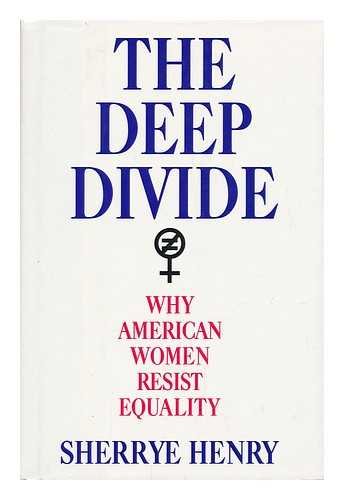
The long-time hostess of a popular WOR Radio interview show examines why so many women disavow feminism and proposes ways to forestall that trend. After an unsuccessful campaign for state senate in which she and other female candidates were not supported by women voters, Henry decided to find out why. A sample of women were chosen and asked their opinions on feminism and what their own needs and priorities were. Henry found hostility and dissatisfaction with the feminist movement; most "mainstream" women interviewed did not want to be identified as feminists. Henry concludes that the leaders of the movement need to reevaluate some of their priorities and tactics. This book provides a basis for discussing the feminist agenda by calling into question some of the movement's basic assumptions. Recommended for all women's studies, high school, and undergraduate collections. --Sharon Firestone, Ross-Blakley Law Lib., Arizona State Univ., Tempe Copyright 1994 Reed Business Information, Inc. Henry thinks American women do not understand equality. A broadcast joumalist for many years, she conceived this book after running for the state legislature on a strong women's rights platform and losing. Wanting to know why more women didn't support her, she devised a study and conducted a series of nationwide focus groups to answer her questions. She found a huge chasm between what women say they want and what they have--a gap that crosses racial, economic, and age lines. She believes the only way to close this gap is for women to develop political agendas that address their needs, vote for female candidates, and make the personal political. Based on research into culture, belief systems, and the nature of power as well as on her study, her book is a call to arms for average American women. Presenting solid suggestions for women to organize politically to get what they want, she wakes women up to the true nature of equality. Mary Ellen Sullivan This book's know-it-all attitude cancels out an interesting issue: the ``self-destructive chasm'' between what American women say they want and their actions. Henry (Alone Together, 1982) is troubled by the question of why we don't have equality when so many women say they want it. To seek the answer, she commissioned a marketing firm to arrange focus groups of women from different geographical areas and question them regarding their feelings about equality at work and in the home. Each group is identified by only one characteristic: The group tagged ``Young Chicago Professionals'' includes only white women; Latina and African-American women have their own groups; and there is a control group of self-proclaimed feminists. The focus group results become a leaping off point for Henry to enter into an unwieldy discussion of various feminist issues. She cites all the correct feminist sources, including Susan Faludi, yet there is a tinge of backlash to the entire project, which rarely gives credence to the idea that women can be held back by forces out of their control. When Henry suggests that feminists need to tone down their rhetoric--not their message--and present a more mainstream front, she reinforces the very representation that she claims has impeded feminism's influence: ``Feminist leaders should re-tool their image from radical embattled 60s demonstrators into contemporary, determined supporters of justice who work within the system whenever possible to accomplish their goals.'' Furthermore, when mainstream women in her focus groups make general comments about the lack of femininity among feminists, Henry interprets it as fear of lesbianism, and she notes rather questionably that ``lesbians have, in fact, spearheaded the movement for years.'' A self-defeating project that bulldozes instead of informing. -- Copyright ©1994, Kirkus Associates, LP. All rights reserved.