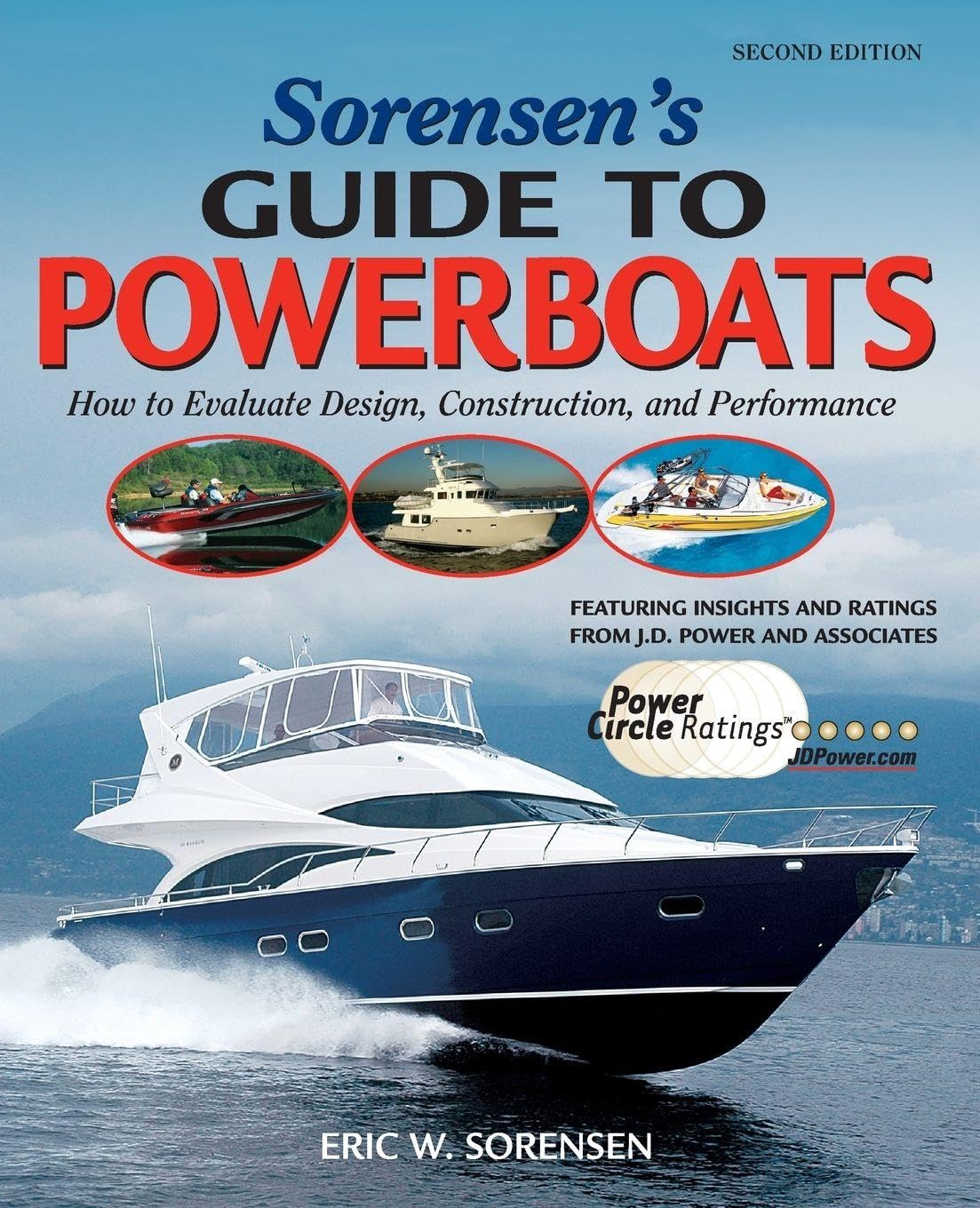
The first book ever to revealwhat boat builders pay thousands ofdollars to learn: the secrets of ownersatisfaction What makes a boat owner happy? Eric Sorensenand J. D. Power & Associates answer that questionin detail in this revised edition of Sorensen’s Guideto Powerboats . Now incorporating results from J. D.Powers’ Boat Competitive Information Study, thisguide tells you everything youneed to know before opening your wallet. From runaboutsand pontoons to express cruisers and bassboats,the book covers it all, explaining the implicationsof different hull designs, construction methods, enginetechnologies, and more. Includes J. D. Power's "PowerCircle" rankings . Eric Sorensen is the former director of marine practice for J.D. Power & Associates and a boat reviewer for national magazines. Eric Sorensen is the former director ofmarine practice for J.D. Power & Associates and a boatreviewer for national magazines. Sorensen's GUIDE TO POWERBOATS How to Evaluate Design, Construction, and Performance By ERIC W. SORENSEN The McGraw-Hill Companies, Inc. Copyright © 2008 Eric W. Sorensen All right reserved. ISBN: 978-0-07-148920-1 Contents Chapter One Introduction Nothing in life is so exhilarating as to be shot at without result. —Winston Churchill Welcome to the wonderful world of boating! You may be getting ready to buy your first boat, or maybe you've owned a series of yachts over the last forty years. But whether you're new to the game or an experienced boater, the more you understand about powerboats and yachts, the better. That's what this book is all about—helping you to better understand powerboat design, construction, and performance; in short, what really makes a boat tick. You'll learn more about the boat you own now—maybe why it porpoises at high speed, whether your hull is likely to blister, or why the bow rises excessively on plane. Or why a semidisplacement hull is really what you've been looking for all along, or the effect of bulwarks on dynamic stability. And of course my hope is that the reader will be a little more discriminating, and have higher expectations, next time around. Choosing your next powerboat or yacht can be a perplexing process. There are hundreds of models to choose from, and most of the magazine ads say pretty much the same thing: that Brand X is the best, a revolutionary advance over the competition. Talk is cheap, however, and results speak volumes. Two boats, one well-designed and engineered and the other anything but, might look very similar during a quick tour at a boat show. But taking a closer look in the right places, asking the right questions, and insisting on a prepurchase sea trial will reveal the great gulf that may lie between the two boats' quality, performance, reliability, and longevity. Even the smallest, simplest boats interact with wind and waves in complex ways. And even if it's basically a hull, an outboard, and a 6-gallon gas tank, you'll want your boat to perform well and to last a long time with minimal maintenance. The bigger the boat, the more complicated it gets with all the extra systems that make life afloat more enjoyable. Whichever boat you end up buying, the more you know about the hull design's capabilities and limitations, the methods and materials used to build it, the propulsion system that makes it go, and the systems that provide fuel, ventilation, electricity, and fresh and salt water, the better off you'll feel about the experience. And feeling good is what owning a boat is all about. Philosophy The first half of the book, chapters 1 through 14 , discusses the theory and engineering underlying good powerboat design, with plenty of illustrations to flesh them out. Here we explore questions such as what makes a boat seaworthy, and whether a displacement or planing hull is best for you, what propulsion system is most appropriate, and what to look for in topside safety, engine compartment access, helm station design, accommodations, and so on. In places this book is opinionated. It reflects, among other things, the philosophy about boats I've developed and refined over recent years evaluating boats for consumers, magazines, and boat-builders. And, perhaps more fundamentally, it reflects the twenty years I spent in the coast guard and navy, where safety was always the driving concern in our operations. Chapters 2 and 12 are dedicated to seaworthiness and safety afloat. Not that I confuse a destroyer with a walk-around very often, but there are elements of design that are common to both, and there is much that the builders of pleasure craft can learn from military and commercial vessels. So the book is informed, among other things, by navy and coast guard design practices and assumptions, and ventures to say where they reasonably apply to your boat. Likewise, I will bring in standards applied to commercial vessels issued by regulatory bodies such as the American Bureau of Shipping