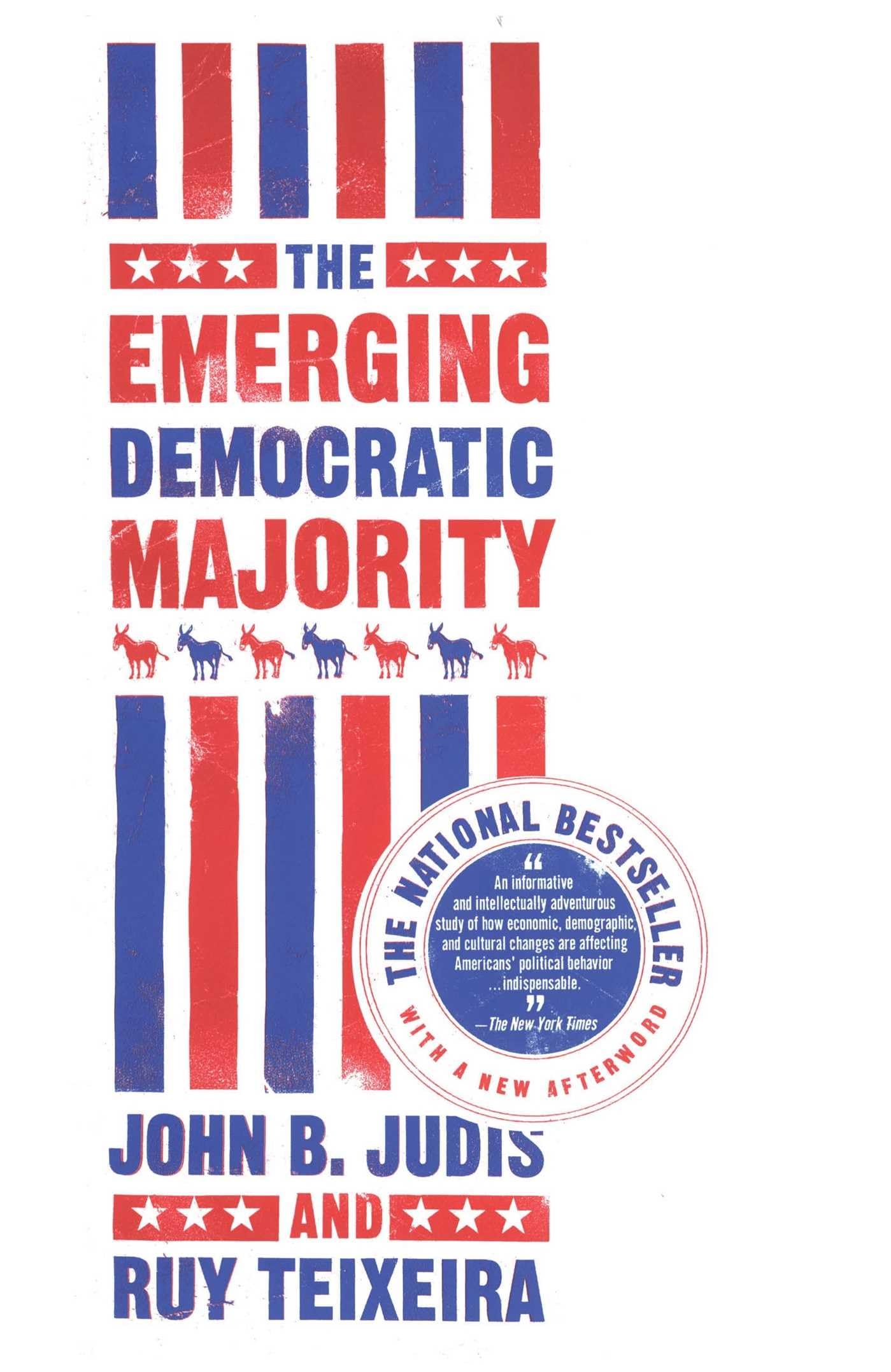
ONE OF THE ECONOMIST' S BEST BOOKS OF THE YEAR AND A WINNER OF THE WASHINGTON MONTHLY' S ANNUAL POLITICAL BOOK AWARD Political experts John B. Judis and Ruy Teixeira convincingly use hard data -- demographic, geographic, economic, and political -- to forecast the dawn of a new progressive era. In the 1960s, Kevin Phillips, battling conventional wisdom, correctly foretold the dawn of a new conservative era. His book, The Emerging Republican Majority, became an indispensable guide for all those attempting to understand political change through the 1970s and 1980s. At the beginning of the twenty-first century, with the country in Republican hands, The Emerging Democratic Majority is the indispensable guide to this era. In five well-researched chapters and a new afterword covering the 2002 elections, Judis and Teixeira show how the most dynamic and fastest-growing areas of the country are cultivating a new wave of Democratic voters who embrace what the authors call "progressive centrism" and take umbrage at Republican demands to privatize social security, ban abortion, and cut back environmental regulations. As the GOP continues to be dominated by neoconservatives, the religious right, and corporate influence, this is an essential volume for all those discontented with their narrow agenda -- and a clarion call for a new political order. Paul Begala cohost, CNN's Crossfire A must-read for every strategist, analyst, and active citizen who wants to understand where our country is going politically. The Washington Post With a keen eye for demographic and cultural trends, Judis and Teixeira argue persuasively that George [W.] Bush's Republican Party is headed for a showdown with the American electorate....An important book. John B. Judis is a senior editor of The New Republic and the author of William F. Buckley, Jr. and The Paradox of American Democracy. Chapter One: The Rise and Fall of the Conservative Republican Majority In 1969, a year after Richard Nixon won the presidency, Kevin Phillips, an aide to Attorney General John Mitchell, published a book entitled The Emerging Republican Majority. The apparent confirmation of its thesis in 1972 -- not to mention Phillips's proximity to the administration -- eventually landed it on the best-seller lists. Like other books of its kind, however, it was cited more often than it was read, and its actual thesis has been clouded by its notoriety. Phillips did not argue that Republicans had already created a majority -- in fact, when he wrote his book, Democrats still controlled both houses of Congress, plus the majority of statehouses. What he argued was that the era of "New Deal Democratic hegemony" was over. Phillips predicted that a new Republican majority would eventually emerge out of popular disillusionment with big government programs and the collapse of the Democratic coalition -- a collapse the 1968 candidacy of Alabama governor George Wallace had foreshadowed. And a Republican majority finally did emerge in 1980, but only after the GOP had rebounded from the Watergate scandal. Our view is that we are at a similar juncture -- but one that will yield the opposite result. We believe that the Republican era Phillips presciently perceived in 1969 is now over. We are witnessing the "end of Republican hegemony." The first signs appeared in the early 1990s -- not merely in Bill Clinton's victory in 1992, but in H. Ross Perot's third-party candidacy and the rise of new kinds of independent voters. The Republican takeover of Congress in November 1994 seemed to show that Clinton's win and Perot's strong showing were flukes. Indeed, many confidently predicted that 1994 heralded the beginning of still another conservative realignment. But the 1994 Republican wins turned out, in retrospect, to be the same kind of false dawn that the Democrats had experienced twenty years earlier because of Watergate. Ever since 1994, Republicans have lost ground in Congress and in the country. Like the Democrats of the 1970s, they have also begun to suffer serious divisions within their ranks -- from Pat Buchanan on the right to John McCain and Jim Jeffords on the left. Bush's aggressive prosecution of the war against the terrorists in the fall of 2001 lifted him in public esteem and may have delayed a Republican collapse in 2002. But once the clouds of war lift, and Americans cease to focus on threats to their national security, Republicans are likely to continue their slide, and the movement toward a Democratic majority is likely to resume. The Republican majority that Phillips foresaw represented a "realignment" of American politics. A realignment entails a shift in the political coalitions that dominate American politics and in the worldview through which citizens interpret events and make political judgments. Realignments happened before in 1860-64, 1896, and 1932-36. These past realignments followed or took place during cataclysmic events -- the conflict ove