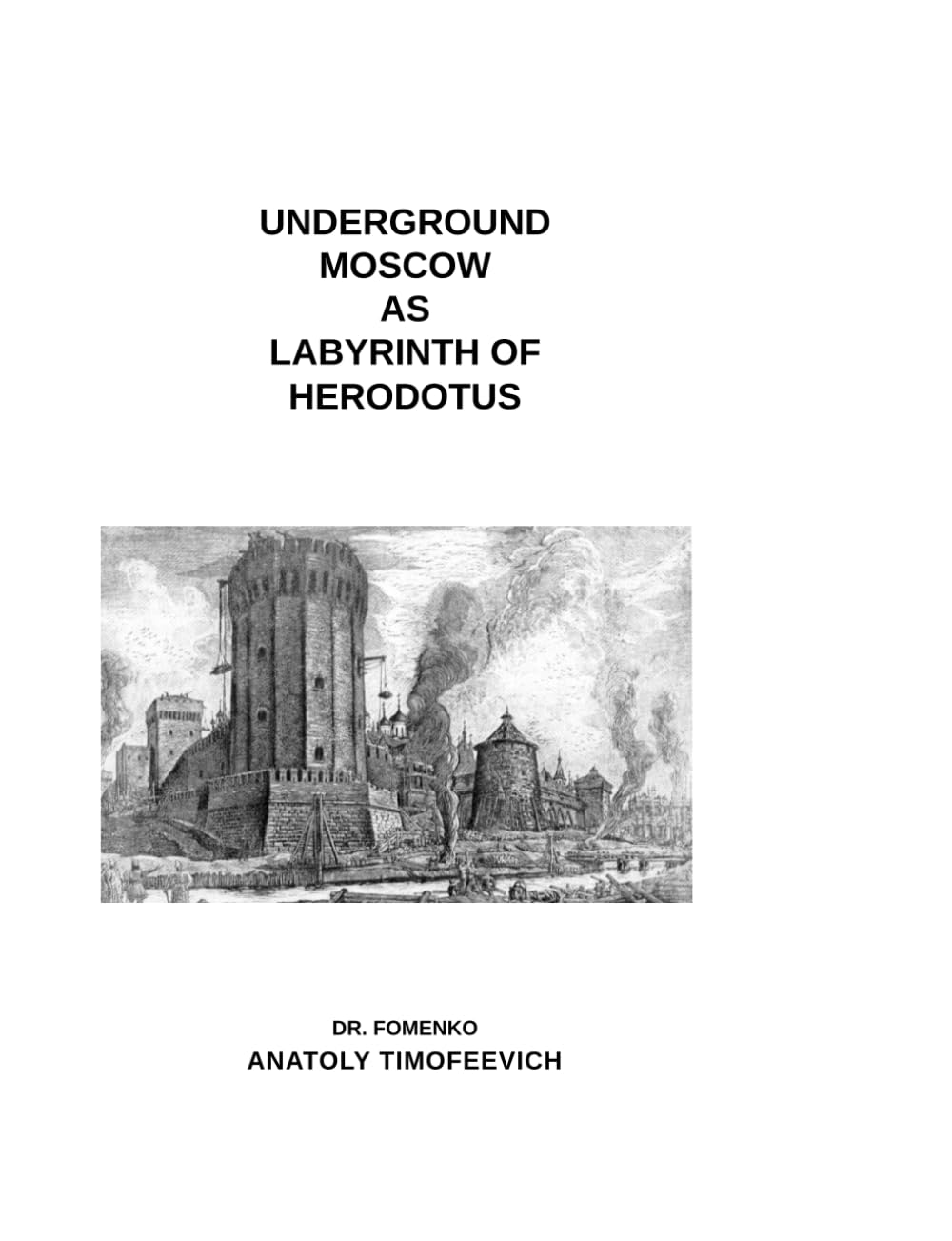
Few people know today that there still are under mod- ern Moscow the remains of a vast underground city sometimes called “underground Moscow.” For several centuries it has been shrouded in myths and legends. It consists of a multitude of underground corridors, galleries, rooms, vast halls, storage facilities, wells, staircases, passages, caches, collapsed chambers, walled doors, flooded tunnels. Many, perhaps even most of them, are lined with white stone. It is believed that somewhere there the famous library of Ivan the Ter- rible is hidden; that through those white-stone tunnels and galleries it is still possible to travel long distances under Moscow; that it is possible to descend under the ground somewhere in the center of the city and get back to the surface far beyond the limits of Moscow and its region, or even in other cities. There is a spe- cial profession—Moscow speleologists, or “Moscow diggers.” These people selflessly spend many years ex- ploring underground Moscow. In their activities, they have to overcome not only the natural difficulties as- sociated with working underground, but also serious obstacles created by the Moscow authorities. The lat- ter, however, is understandable. The ramified system of multilevel underground structures in the capital of Russia is, of course, protected from the intrusion by unauthorized persons for security reasons. As for the “diggers,” little is known of their activity. It is shrouded in an aura of mystery, and the general public, includ- ing scientists, does not know much about it. At the same time, an established fact today is the absence of ancient plans and drawings of underground Moscow. It turns out that already the Romanovs did not have them. The first Romanovs in the beginning had a very vague idea of the impressive scale of the under- ground city ([815:1]). Only later started the searches and random excavations in the hope to stumble upon the buried treasures, or royal archives, or the library of Ivan the Terrible. The history of underground Moscow and its re- search is described in an interesting book by Ignatiy (Ignatiy Yakovlevich) Stelletsky, The Search for the Library of Ivan the Terrible ([815:1]). We will quote it frequently. Note that today there is apparently no detailed scientific literature on the history of under- ground Moscow. Or it is hard to find. In any case, our search for modern scientific books or reviews on this topic gave a very modest result—we have found only one book, that of Ignatiy Stelletsky ([815:1]), and some newspaper and magazine articles. But even in the book of Stelletsky underground Moscow is only covered in passing, since the main subject of his research was the library of Ivan the Terrible. We will focus our atten- tion specifically on underground Moscow since we have already expressed our point of view regarding the library of Ivan IV in Chron4, 14:1.3. Let us recall that, according to our results, the Rus- sian Czar-Khan of the XIV-XVI centuries was the Egyp- tian Pharaoh of the Bible (some of the Bible’s books were written at that time), and his capital in the Al- exandrov Sloboda could have been called (and appar- ently was called) Alexandria of Egypt. Therefore, the Alexandrov Sloboda could be associated with the in- formation about the famous “antique” Library of Al- exandria, that is, about the legendary library of Ivan the Terrible, which probably was for some time located in the Alexandrov Sloboda ([11], p. 6) and could well be called the Alexandrian Library. If so, the destruc- tion of the “antique” Library of Alexandria by the fire might reflect the actual fact of the complete defeat of the Alexandrov Sloboda in the Romanovian era of the XVII century. Most likely, the library of Ivan the Terrible was destroyed and burned on the orders of the Romanovs. As we describe in Chapter 10 of Chron6, Moscow, as the new capital of Russia-Horde, began to be built only in the XVI century, under Ivan the Terrible.