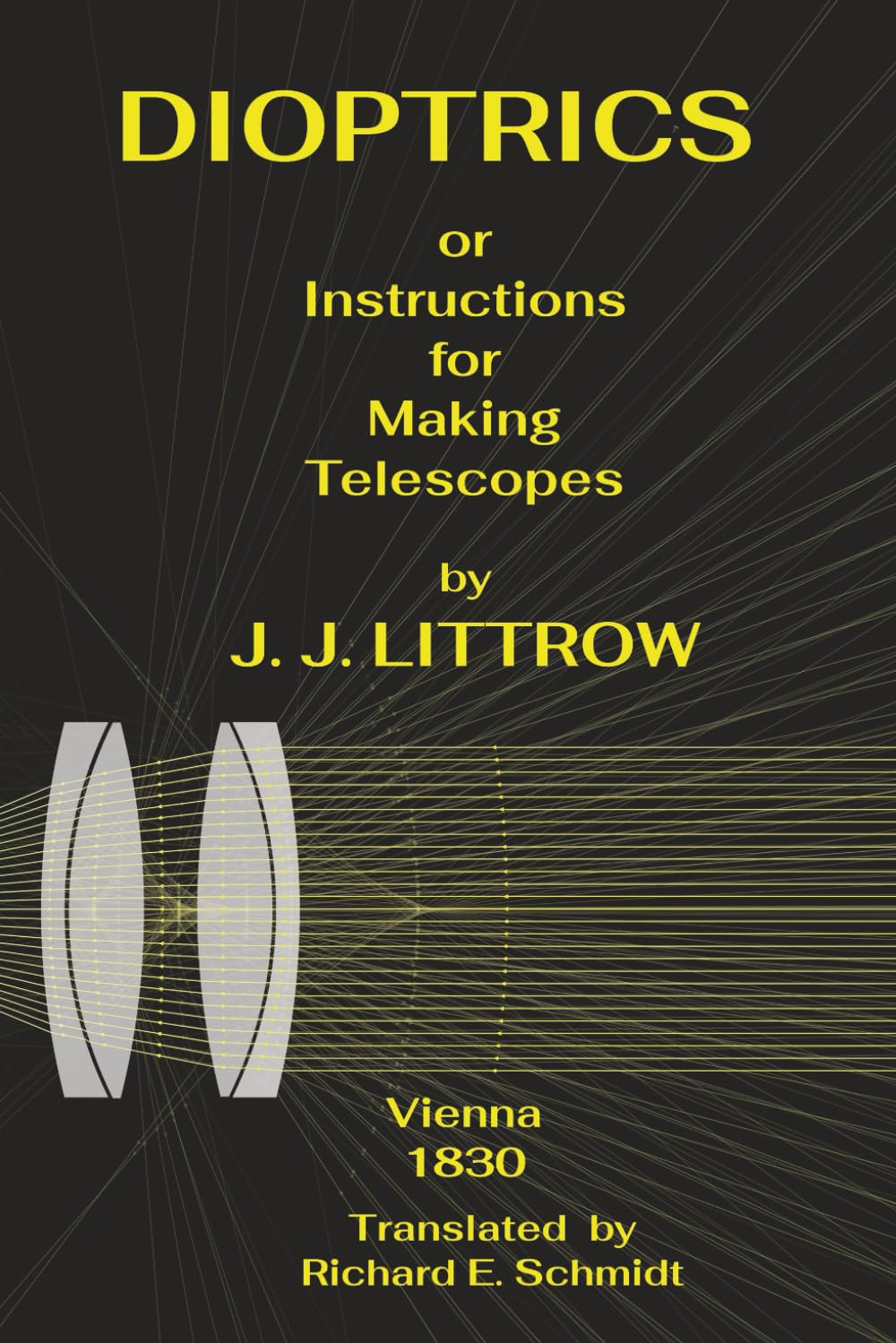
Dioptrics, or Instructions on Making Telescopes , J. J. Littrow's monumental 1830 text, appears for the first time in an English language translation. Littrow’s purpose in writing Dioptrics was to provide a comprehensive supplement of mathematical theory behind the general design of the objective lenses and oculars of telescopes and microscopes. As Sir John Herschel wrote in 1821, from all of the work of mathematicians on the theory of telescope optics, "nothing hitherto has resulted beyond a mass of complicated formulae, which, though confessedly exact in theory, have never yet been made the basis of construction for a single good instrument." The Imperial and Royal Polytechnic Institute of Vienna was established in order to grow Austrian industry through the teaching of scientific principles to its practitioners and craftsmen. Professor Littrow tutored Vienna's optical artists, among them Simon Plössl. Littrow’s book is divided into three major sections: “The Theory of Objectives”, “The Theory of Oculars”, and “A Brief History of Optics”. In the first section we learn what Fraunhofer was up to when he discovered his eponymous solar absorption lines: he was determining the dependence of the indices of refraction of types of glass upon the colors of rays. We also see demonstrated how a telescope computed to be “excellent” by Euler turns out to be far from it when geometric approximations are discarded. We learn about the design of doublet objectives and derive Sir John Herschel’s equations for a perfect objective, analyze the dimensions of some Fraunhofer objectives, and learn to correct for the two effects that limit optical performance, namely spherical and chromatic aberration. In the eighth chapter of the first section, we follow Littrow as he uncovers a remarkable method for significantly reducing both the expense of a refractor and a shortening of its length, the computations that in two years aided Plössl in the production of the first dialyte, the astronomical telescope with the flint objective lens moved to the center of the tube, thus reducing the need for difficult-to-produce flint lenses. In the second section of Dioptrics, Littrow breaks down in detail the features and limitations of various eyepiece designs, and derives general formulae for field of view, magnification, and placement of the eye in oculars. He discusses oculars with multiple elements, including Fraunhofer’s terrestrial eyepiece designs, and he details practical methods of objective lense assembly and centering. A chapter on microscope design is followed by one on reflecting optics (catadioptrics). Section three provides a brief but illuminating history of optics from the earliest of times to Littrow’s era, one that is completely devoid of mathematics. This English language edition of Littrow’s great work is not intended as a guide to the production of telescope optics in the present era, where far more advanced theory and computational software is widely available. But it is hoped that it will provide anyone interested in the history of science with a detailed look into the state of optical engineering of the early 19th century, and further may act as a tribute to its author.